


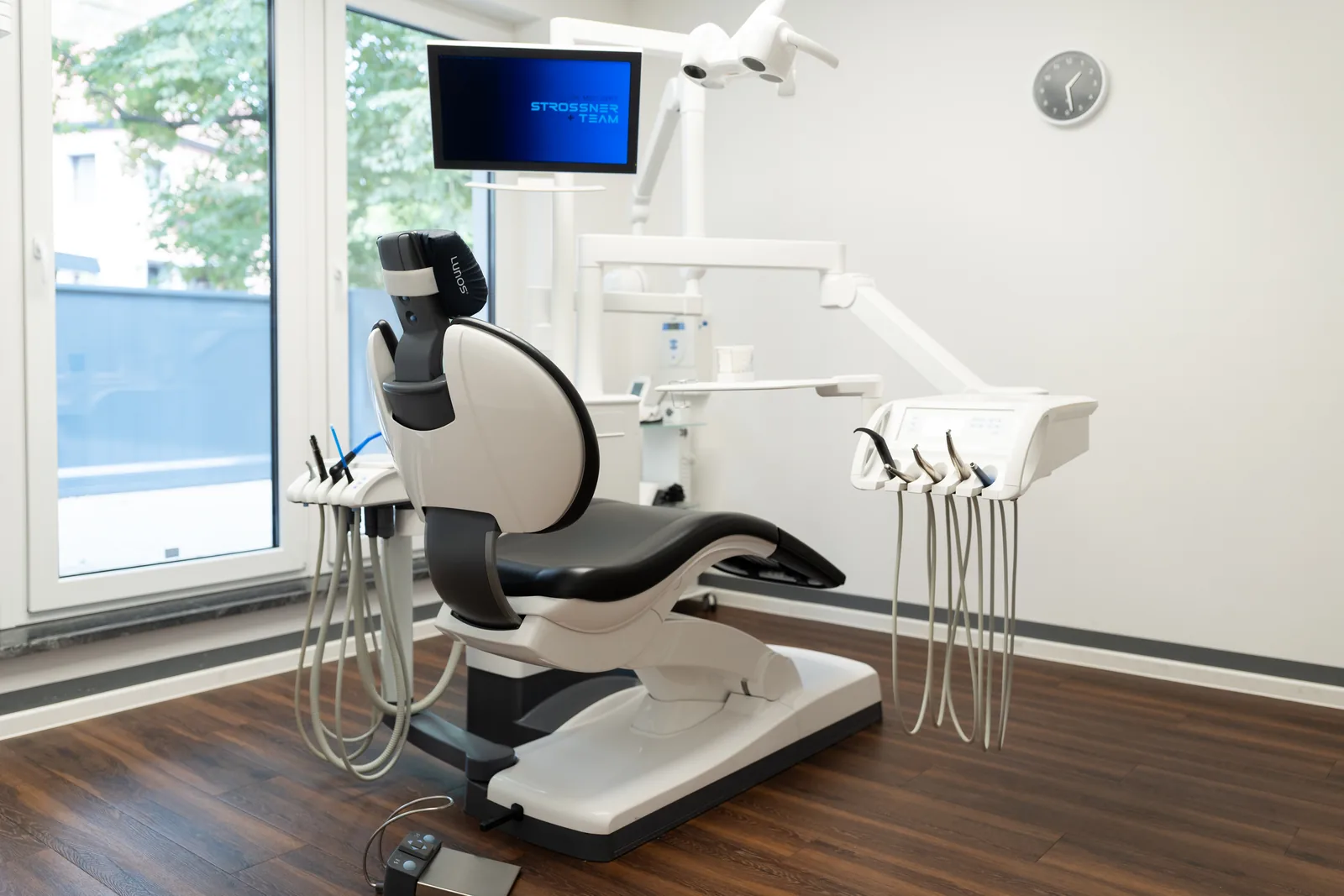
Our Medical Technology
From X-ray to finished tooth, with no detours
For us, digital does not mean “modern for technology's sake” – it means fewer impressions, fewer appointments and fewer surprises.
Who treats you
Dr. med. dent. M.Sc. Sandro Strößner – working in implantology since 2013 · M.Sc. in Oral Implantology and Periodontology – together with the team at Zahnkompetenzzentrum Weißenfels.
First Appointment
Consultation, medical history and examination (3D X-ray if needed) – we plan first and treat later. A pure information meeting without examination is non-binding; the examination and the cost plan are charged according to the GOZ fee schedule.
Costs
A written treatment and cost plan before treatment begins; an initial, non-binding price range is provided by the cost calculator further down.
First Step
Appointments online around the clock (“Appointment” button) or by phone during opening hours on 03443 339 65 54.
“All-on-4: a completely toothless jaw, or one requiring full restoration, is fitted with just four implants, positioned so that stable anchorage is possible even where bone volume is reduced.”
The Principle
Cone-beam CT scan, intraoral scans, structured assessment. The first appointment isn't treatment — it's a conversation backed by data.
From the final dental prosthesis back to the surgery. What should exist at the end determines the first step — not the other way round.
One team under one roof: surgery, prosthetics, laboratory.
Our Medical Technology
For us, digital does not mean “modern for technology's sake” – it means fewer impressions, fewer appointments and fewer surprises.
01
03
05
After a healing period of 4–6 months, the provisional bridge is replaced with a high-quality, definitive restoration (usually all-ceramic or a hybrid).
Short videos in which our team answers the questions we're asked most often. No jargon, no sales pressure.
The videos provide general information and do not replace individual advice or examination. The course and outcome of treatment depend on personal circumstances; medicine offers no guarantee of success. All videos have subtitles.
Fixed Dental Restoration on Four Implants
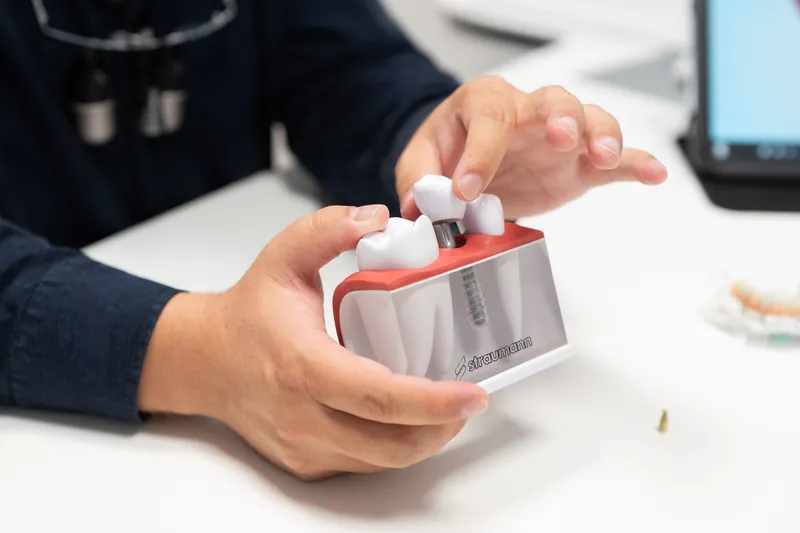
All-on-4 describes a treatment concept in which complete, fixed dental prosthetics for a toothless jaw, or one in need of full restoration, are anchored on just four implants. Instead of removable dentures resting on the gum, the dental bridge is permanently connected to the implants. This creates dental prosthetics that stay in the mouth and, as a rule, sit like your own teeth in the jaw when speaking, laughing and eating.
The name All-on-4 is meant literally: an entire row of teeth – “all” – is supported on four implants. What is special is the positioning of these four artificial roots. The two front implants are placed largely vertically into the jawbone. The two rear implants are deliberately angled. This angling is no accident, but the heart of the concept: it makes it possible to make optimal use of the available bone and to avoid areas where anatomical structures, such as the maxillary sinus in the upper jaw or the nerve canal in the lower jaw, would otherwise stand in the way of straight implant placement.
The Zahnkompetenzzentrum Dr. med. dent. M.Sc. Sandro Strößner in Weißenfels supports patients through this form of fixed restoration, from the initial consultation, through planning and the surgical procedure, to long-term aftercare. Treatment is tailored individually to your particular oral situation, anatomical circumstances and personal expectations. No general statement about the outcome can be made in advance – every restoration begins with a careful examination and a personal conversation.
It is important to distinguish this from classic single implants. Anyone wanting to close a single missing tooth gap generally needs one implant with a crown. All-on-4, by contrast, is aimed at people whose entire upper or lower jaw is affected – whether because all teeth are already missing, an old denture needs replacing, or the remaining teeth can no longer be saved due to advanced periodontitis or decay. In such cases, it would be neither necessary nor sensible to place a separate implant for every single tooth. Four strategically placed implants can bear the load of a complete bridge.
Who this procedure is suitable for
Not every oral situation is equally suited to every procedure. Whether All-on-4 could be an option for you personally can only be assessed responsibly after an examination at the practice. However, there are typical starting situations in which this concept is often considered. These include, in particular, people who already have an edentulous jaw, or who are likely to have one in the foreseeable future because the remaining teeth can no longer be saved.
A generally acceptable state of health is always a prerequisite for implant treatment. Certain underlying medical conditions, uncontrolled diabetes mellitus, ongoing treatment with certain osteoporosis medications, or heavy smoking can affect healing and the integration of the implants. Such factors do not automatically rule out treatment – but they must be discussed openly in advance and taken into account in planning. The presence of sufficient healthy jawbone also plays a central role and is assessed using three-dimensional X-ray diagnostics.
Anyone wanting to replace just a single gap or a few missing teeth, and who otherwise has a stable, healthy set of teeth, is usually better served with single implants or smaller bridge solutions. There are also situations in which, for medical reasons, other steps should come first – for example, treating periodontitis or targeted bone augmentation. At the Zahnkompetenzzentrum in Weißenfels, we therefore first assess which approach suits your situation, before making a recommendation. Honest information about alternatives is part of every consultation.
Explained step by step
All-on-4 treatment follows a structured, multi-stage process. The individual steps interlock and are planned with great care at the Zahnkompetenzzentrum Dr. Strößner, as the quality of preparation largely determines how smoothly the actual procedure and the subsequent restoration proceed. The following overview shows the typical path – the exact details always depend on your individual situation.
The time between the individual steps varies depending on the starting situation. While the implant placement itself and fitting the provisional bridge often take place on the same day, the entire treatment through to the final bridge extends over several months. This time is medically necessary, as the firm fusion of the implants with the bone cannot be sped up.
The Structural Principle Behind It
At first glance, it may seem surprising that a complete row of teeth can rest on just four implants. The answer lies in the carefully considered distribution and alignment of these four supporting posts. A fixed bridge spanning across the jaw distributes the forces generated during chewing across all the anchor points. What matters here is that the supporting posts are far enough apart to support the bridge stably.
The two rear implants are deliberately placed at an angle. This angling achieves two things. First, it moves the rear anchor point of the bridge further back, without needing to implant deeply into the bone at that point. This gives the bridge more support in the molar area. Second, this approach makes it possible to avoid sensitive anatomical structures: in the upper jaw, the area of the maxillary sinus is spared, and in the lower jaw, the path of the inferior alveolar nerve. These structures are often precisely the reason why implants in the back of the jaw would otherwise require extensive bone augmentation.
By making skilful use of the bone that is often better preserved in the front section of the jaw, this concept can, in many cases, manage without extensive augmentation. For some people, this is what makes treatment possible in the first place, where conventional, vertically placed implants would have required more extensive preliminary treatment. Whether this also applies in your case depends on your individual bone volume and is assessed using three-dimensional diagnostics.
The four implants do not function as isolated individual pillars, but are joined into a single unit by the firmly screwed-on bridge. This rigid splinting ensures that chewing forces are distributed across the whole structure, so that no single implant is overloaded. A precondition for this principle, however, is that the implants already have sufficient stability in the bone at the time of placement. This so-called primary stability is checked during the procedure and is an important condition for whether immediate treatment with the provisional bridge is possible.
Fixed teeth, often in a single day
One aspect of the All-on-4 concept is the possibility of so-called immediate loading. This means that, under suitable conditions, the implants can be fitted with a fixed temporary bridge immediately after placement. The term “Fixed Teeth in a Day” describes exactly this approach: in many cases, patients leave the practice after the procedure not with an empty jaw or a removable interim solution, but with fixed temporary teeth.
This option is, however, subject to certain conditions and cannot be taken for granted. Whether immediate loading can be responsibly carried out in an individual case is only decided during the procedure itself, based on how firmly the implants have taken hold in the bone. If the necessary primary stability cannot be achieved, it is medically preferable to allow the implants a quieter healing phase first and to fit the fixed restoration later. Such a decision serves solely the long-term success of the treatment and is discussed with you openly.
The provisional bridge fulfils several functions at once. It immediately gives you back a visible, fixed row of teeth, so that you do not have to get through the period until the final restoration without teeth, or with a loose denture. At the same time, it protects the healing implants and helps shape the gum favourably. It is deliberately designed as a transitional solution and can generally bear somewhat less load than the later definitive dental prosthetics – which is why dietary guidance during this period matters so much.
Once healing is complete, the provisional bridge is replaced with the final dental restoration. This is tailored to you individually in terms of fit, tooth colour, tooth shape and function, and is made through a dental laboratory process. The interval between the provisional and the final restoration gives both the bone and the gums the opportunity to stabilise before the long-term bridge is fitted.
The difference in everyday life
Anyone who has worn a removable full denture for years knows the typical limitations: the sense of hold that fades over time, uncertainty when eating firm food, the palatal plate in the upper jaw that is often felt to be intrusive, and having to remove the dental prosthetics for cleaning. A fixed, implant-supported restoration addresses exactly these points.
These advantages do not mean that removable dental prosthetics are fundamentally the worse choice. For some people, a removable solution – such as a denture supported by a small number of implants – is the more suitable restoration for medical, anatomical or personal reasons. Which form is right for you depends on your individual situation. At the Zahnkompetenzzentrum in Weißenfels, the options available, along with their respective characteristics, are discussed with you openly, so that you can make a well-informed decision.
Care, Healing and Costs
A fixed implant restoration is an investment designed to last many years. For it to give you pleasure for many years, what matters is not only the procedure itself, but equally your cooperation during the healing phase and consistent care in everyday life. The financial side is also part of honest information from the outset.
The basis of every implant placement is sufficient load-bearing jawbone at the planned positions. This is exactly where the All-on-4 concept shows its strength, because the angled rear implants make particularly efficient use of the available bone. Nevertheless, before every treatment, three-dimensional diagnostics are used to check whether the available bone is sufficient or whether preparatory measures make sense. General health factors, good oral hygiene, and, where necessary, prior treatment of gum disease are also taken into account.
After the procedure, the phase begins in which the bone fuses with the implant surfaces. This fusion (osseointegration) is the basis for the implant's later load-bearing capacity and takes several weeks to months. During this time, it is important to follow the practice's guidance: soft food for the first few days, careful oral hygiene, and avoiding excessive strain on the temporary bridge. Temporary swelling or a feeling of tightness after the procedure is not unusual and generally subsides. If you have questions or notice anything unusual, the practice is your first point of contact.
Implant-supported dental prosthetics require conscientious daily care. In addition to thorough tooth-brushing, aids such as interdental brushes, special floss for bridges, or an oral irrigator are used to keep the areas where the bridge meets the gum clean as well. In addition, regular check-ups and professional dental cleaning at the Zahnkompetenzzentrum are an essential part of aftercare. These help to keep an eye on the condition of implants, gums, and bridge, and to adapt care to your particular situation. Consistent aftercare is one of the most important factors for restorations that stay stable for many years.
The cost of All-on-4 treatment cannot be stated as a flat rate, as it depends on many individual factors – such as the number of jaws to be treated, any preparatory treatment needed, such as tooth extraction, the chosen design of the dental prosthetics, and the dental laboratory work involved. For this reason, you will always receive an individual, written treatment and cost plan before treatment begins, setting out the expected costs transparently. For fixed dental prosthetics on implants, statutory health insurers grant a fixed subsidy based on the diagnosis, which is based on the condition of your jaw and covers part of standard care; the remaining share is paid privately. Anyone able to show a dental bonus booklet (Bonusheft) kept up to date without gaps over the years can increase the fixed subsidy. Privately insured patients and those with supplementary dental insurance should clarify the scope of cover with their insurer in advance. The team at the Zahnkompetenzzentrum Dr. Strößner is happy to advise you on cost-planning options and instalment payment plans. For a personal consultation, you can reach the practice in Weißenfels on 03443 339 65 54.
The Zahnkompetenzzentrum Dr. med. dent. M.Sc. Sandro Strößner is here in Weißenfels for people who are interested in fixed dental prosthetics on implants. Whether you come from Weißenfels itself, from the Burgenlandkreis or from the surrounding towns – the first step is always a personal consultation, in which your situation is examined and your questions are answered without any rush. Only then can a reliable assessment be made as to whether, and in what form, All-on-4 treatment is an option for you. Feel free to arrange an appointment for this on 03443 / 339 65 54.

All-on-4: A completely toothless jaw, or one that requires full rehabilitation, is restored with just four implants, positioned in such a way that stable anchorage is possible even with reduced bone volume. Usually without extensive bone augmentation. You often receive a firmly screw-retained temporary bridge on the very same day.
Fixed teeth in a day has been a focus of our Zahnkompetenzzentrum for years. “All-on-4®” is a manufacturer's brand (Nobel Biocare) for this well-documented treatment concept on four implants. Digital 3D planning, generally navigated surgery, and close coordination with our master laboratory make the process easy to plan.
What convinced me was the absence of marketing. No promises. Just planning, explanation, execution. I had eight implants placed and didn't even feel like I'd made a difficult decision.
At the Zahnkompetenzzentrum
3D-Planned Implants
Book a consultation
Straight to consultation, no detours
All Services at a Glance
No-Obligation Cost Calculator
Process, Technique, Immediate Treatment
Upload your cost plan, call-back within two working days
Computer-navigated implant placement in real time. See how an implant procedure takes place at our Zahnkompetenzzentrum.
This video contains no spoken content. The audio track consists solely of subtle background music — no spoken or meaning-bearing audio information is lost.
Your path to fixed teeth
If you no longer dare to eat out, you don't need a brochure – you need answers in the right order. Here they are.
Three things decide: how much bone there is, how your gums are doing and whether you are healthy enough for a procedure. A loose denture, missing teeth or teeth that cannot be saved are the norm, not the exception.
We clarify that with a 3D X-ray in a matter of minutes. You see your jaw on the screen and find out which solution will hold there. Honestly – even if the answer is: the bone needs to be built up first.
Consultation with 3D diagnostics

Not every jaw needs the same thing. Together we choose from five options, with their pros and cons and what each involves for you.
In the morning, you arrive with a companion; treatment usually takes place under sedation or general anaesthesia with an anaesthesia team on our premises. Teeth that cannot be saved are removed, the implants are generally placed with navigation according to the 3D planning, and with All-on-4 you often leave on the same day with a fixed temporary from our laboratory. After a rest period with us, you go home; from the evening onwards, the aftercare companion gets in touch on your phone.
Our out-of-pocket amounts are published openly on the website: removable on locators 10,400 to 16,200 € per jaw (in the lower jaw from two, in the upper jaw at least four implants), fixed 15,000 to 24,000 € per jaw, with the fixed subsidy from the statutory health insurance already deducted. The calculator below shows your range in a minute, instalment payment included. The written treatment and cost plan is what is binding.
We show examples from our practice on the practice website as before-and-after pairs with a case description, and in consultation using cases similar to yours. Every result depends on the initial findings; we make no promises, but we do make plans.
Dr. med. dent. M.Sc. Sandro Strößner, Master of Science in Oral Implantology and Periodontology, placing implants since 2013, member of the DGI. Alongside him: a cooperating anaesthesia team on our premises, our in-house dental technicians and a prophylaxis team that continues to look after you after treatment.
A no-obligation information consultation, at a table rather than in the treatment chair. You bring your questions, we bring the plan. Book online or call: 03443 339 65 54.
All details describe the typical process in our practice. What it looks like for you is decided by the findings; the written treatment and cost plan is what is binding. Dr. Strößner is the practice owner; employed dentists are identified as such on the team page.
Answer a few short questions and you’ll immediately receive a transparent price range for your situation — complete with a clear breakdown and possible monthly instalment.
As a rule X-Guide 3D-navigated & minimally invasive. We plan your implant on the computer and, as a rule, place it with navigation to within a millimetre — through a particularly small, tissue-sparing access point. This extra effort is already built into every price.
You now know your approximate investment. In the information consultation we clarify which restoration makes sense for your case – and whether there might be a simpler way.
A no-obligation information meeting, without treatment. Examination, any necessary X-ray diagnostics and the written treatment and cost plan are carried out according to medical indication and charged under the GOZ; we tell you the costs in advance. You decide at your leisure.
A non-binding estimate for initial guidance only — not a treatment and cost plan, and no substitute for a personal consultation. The actual cost depends on your individual findings and is set out in a written treatment and cost plan showing the expected costs.
Get practical dental health tips and news from our practice — free, and you can unsubscribe at any time.
